Blast Freezer Manufacturer & Blast Freezing Solutions in India
High-Performance Blast Freezing Systems Designed & Engineered by AWOTECH
AWOTECH – Beyond the Technology
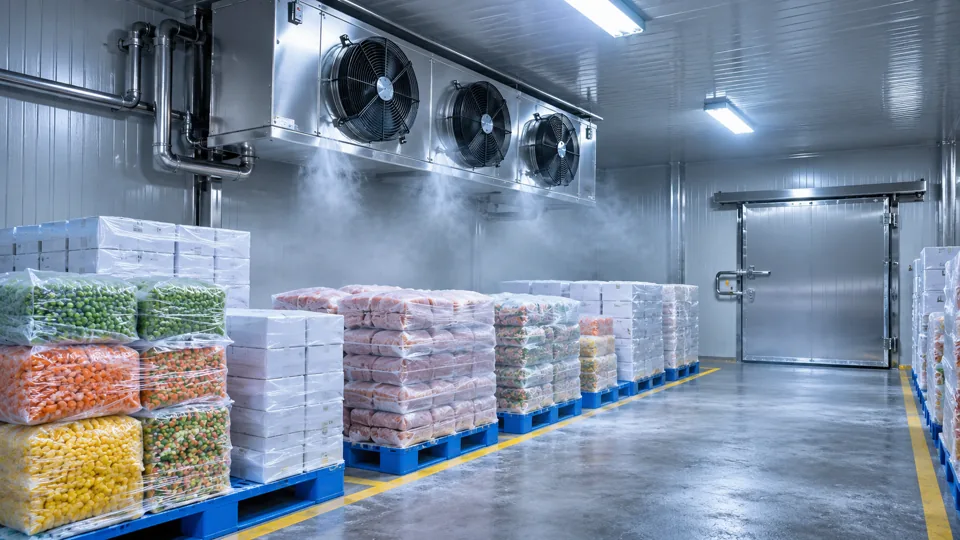
Awotech provides engineered blast freezer and blast freezing solutions in India for food processing, frozen foods, fruits and vegetables, dairy products, meat, poultry, seafood, bakery products, ready-to-eat foods and other suitable temperature-sensitive applications.
Our approach is based on product performance:
Product → Initial Temperature → Required Core Temperature → Batch Capacity → Freezing Time → Refrigeration Load → Airflow → System Design
What is Blast Freezing?
Blast freezing is a rapid freezing process in which very cold, high-velocity air is circulated around and through the product load to remove heat quickly.
Blast Freezing = Rapid Product Freezing
Frozen Cold Storage = Maintaining Frozen Product Temperature
How Does a Blast Freezer Work?
Product Receiving → Preparation / Packing → Blast Freezer Loading → Rapid Heat Removal → Product Core Temperature Monitoring → Freezing Completion → Frozen Storage → Dispatch
Heat is removed as sensible heat above freezing, latent heat during phase change, and sensible heat below freezing.
Complete Blast Freezing Solutions
Blast freezer design and engineering; product freezing-load calculation; refrigeration heat-load calculation; PUF/PIR insulated chamber; freezer doors; low-temperature refrigeration; compressors; evaporators; high-velocity air circulation; air distribution; refrigerant piping; electrical panels; PLC controls; product temperature monitoring; data logging; alarms; remote monitoring; installation; commissioning; operator training; AMC.
Blast Freezer Applications
Fruits & Vegetables: green peas, sweet corn, fruits, vegetables, processed produce and frozen ingredients.
Meat & Poultry: chicken, meat, poultry products, processed meat and ready-to-cook products.
Seafood: fish, shrimp, prawns, processed seafood and packaged seafood.
Dairy: ice cream applications, frozen dairy products, butter and other suitable dairy foods.
Bakery & Prepared Foods: bakery products, frozen dough, RTE, RTC, frozen snacks and prepared meals.
Blast Freezer Temperature
There is no single temperature suitable for every product. Design considers product, initial temperature, final core temperature, size, thickness, packaging, batch quantity, freezing time, air velocity and refrigeration capacity. For many food applications, blast-freezer air temperatures may be designed approximately in the -30°C to -40°C range; the actual design condition must be determined from the specific product and process.
Product Core Temperature
Room temperature alone does not confirm proper freezing. Awotech designs around Required Product Core Temperature + Required Freezing Time. Product temperature probes can be integrated into the control system for suitable applications.
Blast Freezing Time & Capacity
Freezing time depends on product type, dimensions, thickness, initial/final temperature, packaging, loading density, air temperature, air velocity and arrangement.
Batch Capacity × Number of Batches per Day = Daily Freezing Throughput
Capacity planning considers tonnes/day, kg/batch, number of batches, cycle hours, loading/unloading time and production schedule.
Blast Freezer Heat Load Calculation
The refrigeration load may include product sensible heat, product latent heat, heat removal below freezing, packaging, transmission, infiltration, door opening, people, fan motors, lighting, defrost, equipment and other process loads. Refrigeration capacity is matched to the desired freezing cycle.
Airflow Engineering
Refrigeration Capacity Alone is Not Enough. High refrigeration capacity without proper airflow can still cause slow or uneven freezing. Awotech evaluates air velocity, air quantity, product/rack/trolley arrangement, spacing, supply and return paths, fans, pressure drop, bypass and evaporator location.
High-Velocity Air Circulation
Blast freezing requires intensive air movement. Depending on the application, loading can be designed for trolleys, racks, trays, pallets, crates, cartons, hanging products and application-specific systems. Correct stacking and product arrangement are part of the freezing process.
Blast Freezer Refrigeration System
Possible architectures include DX refrigeration, packaged low-temperature systems, multi-compressor systems, centralised refrigeration, industrial refrigeration and application-specific refrigerant solutions. Selection considers evaporating temperature, condensing conditions, capacity, part-load operation, energy, safety, refrigerant strategy, maintenance and future expansion.
PUF/PIR Insulated Blast Freezer
Low-temperature operation makes insulation and vapour sealing critical. Engineering considers insulation material, panel thickness, thermal performance, joints, vapour barrier, ceiling, freezer door, service penetrations, floor insulation, floor vapour barrier and low-temperature requirements.
Blast Freezer Floor
Floor engineering can include floor insulation, vapour barrier, load-bearing requirement, surface finish, drainage, frost protection and under-floor heating or ventilation where required. Poor floor design can create long-term operational and structural problems.
Defrost System
Ice can accumulate on evaporator coils due to moisture entering the chamber and moisture released during loading. Suitable options may include electric defrost, hot-gas defrost or other application-specific systems. Defrost frequency should be optimised for performance and energy.
Blast Freezer Doors
Options can include hinged freezer doors, sliding freezer doors, application-specific industrial doors, door heaters where required and door-position sensors. Door-opening management is important for temperature stability and energy efficiency.
Blast Freezer Automation
PLC/automation can monitor and control room temperature, product core temperature, compressor operation, evaporator fans, defrost, refrigeration pressures, door status, freezing cycle, alarms, historical data, energy consumption and remote monitoring. Cycles may be controlled by time, temperature or application-specific logic.
Blast Freezer vs Frozen Cold Storage
Blast Freezer: rapidly removes product heat and freezes the product within a defined cycle.
Frozen Cold Storage: primarily maintains already-frozen products at the required storage temperature.
Processing → Blast Freezing → Frozen Cold Storage → Refrigerated Dispatch
Blast Freezer vs IQF
Blast freezing generally freezes products in batches using high-velocity cold air. IQF (Individual Quick Freezing) freezes individual pieces separately and rapidly, generally in a continuous or specialised processing line. The choice depends on product, capacity, final product format and investment.
Integrated Frozen Food Facility
Raw Material Receiving → Sorting / Preparation → Processing → Pre-Cooling / Chilling where required → Blast Freezing / IQF → Packing → Frozen Cold Storage → Refrigerated Dispatch
Multi-Chamber Blast Freezing Facility
Blast Freezer 1 → Loading
Blast Freezer 2 → Active Freezing
Blast Freezer 3 → Unloading / Next Cycle
Benefits can include production flexibility, continuous batch movement, reduced dependency on one chamber, maintenance flexibility and better scheduling.
Energy-Efficient Blast Freezing
Awotech evaluates compressor selection and sequencing, condensing conditions, evaporators, fan efficiency, VFD applications, airflow optimisation, insulation, door management, defrost optimisation, batch scheduling, automation and energy monitoring to optimise lifecycle operating cost.
Blast Freezer Modernisation & Retrofit
Existing systems may suffer from long freezing time, uneven freezing, high power consumption, ice formation, poor airflow, compressor problems, inadequate capacity or obsolete controls. Possible upgrades include refrigeration optimisation, evaporator/fan/compressor upgrades, airflow modification, automation, VFD, defrost optimisation, insulation improvement and energy monitoring.
Turnkey Blast Freezer Projects
Product Study → Batch Capacity → Initial & Final Product Temperature → Required Freezing Time → Freezing Load Calculation → Refrigeration Design → Airflow Engineering → Chamber Design → Equipment Selection → Automation → Installation → Testing → Commissioning → Performance Evaluation → Operator Training → Lifecycle Support
Why Choose AWOTECH?
Product-Based Engineering: designed around quantity, temperature, dimensions and freezing time.
Freezing Load Calculation: sensible heat, latent heat and required cycle considered.
Airflow Engineering: high-velocity distribution matched to loading arrangement.
Complete Refrigeration Solution: refrigeration, insulation, airflow, controls and automation integrated.
Food Processing Integration: integrates with processing, IQF, packing and frozen storage.
Automation Ready: product core temperature, room conditions and freezing cycles can be monitored.
Lifecycle Support: commissioning, preventive maintenance, AMC, retrofit and technical support.
Rapid Freezing. Engineered Performance.
Planning a blast freezer, frozen-food facility, meat or seafood freezing plant, vegetable freezing facility or integrated IQF and frozen-storage project?
Share Your Project Details
Project Location | Product | Daily Production | Batch Capacity | Initial Product Temperature | Required Final Core Temperature | Desired Freezing Time | Packaging / Product Dimensions
Our engineers can evaluate the required freezing load, refrigeration capacity, chamber configuration, airflow and automation architecture for your project.
Request a Technical Consultation → Request a Quote →